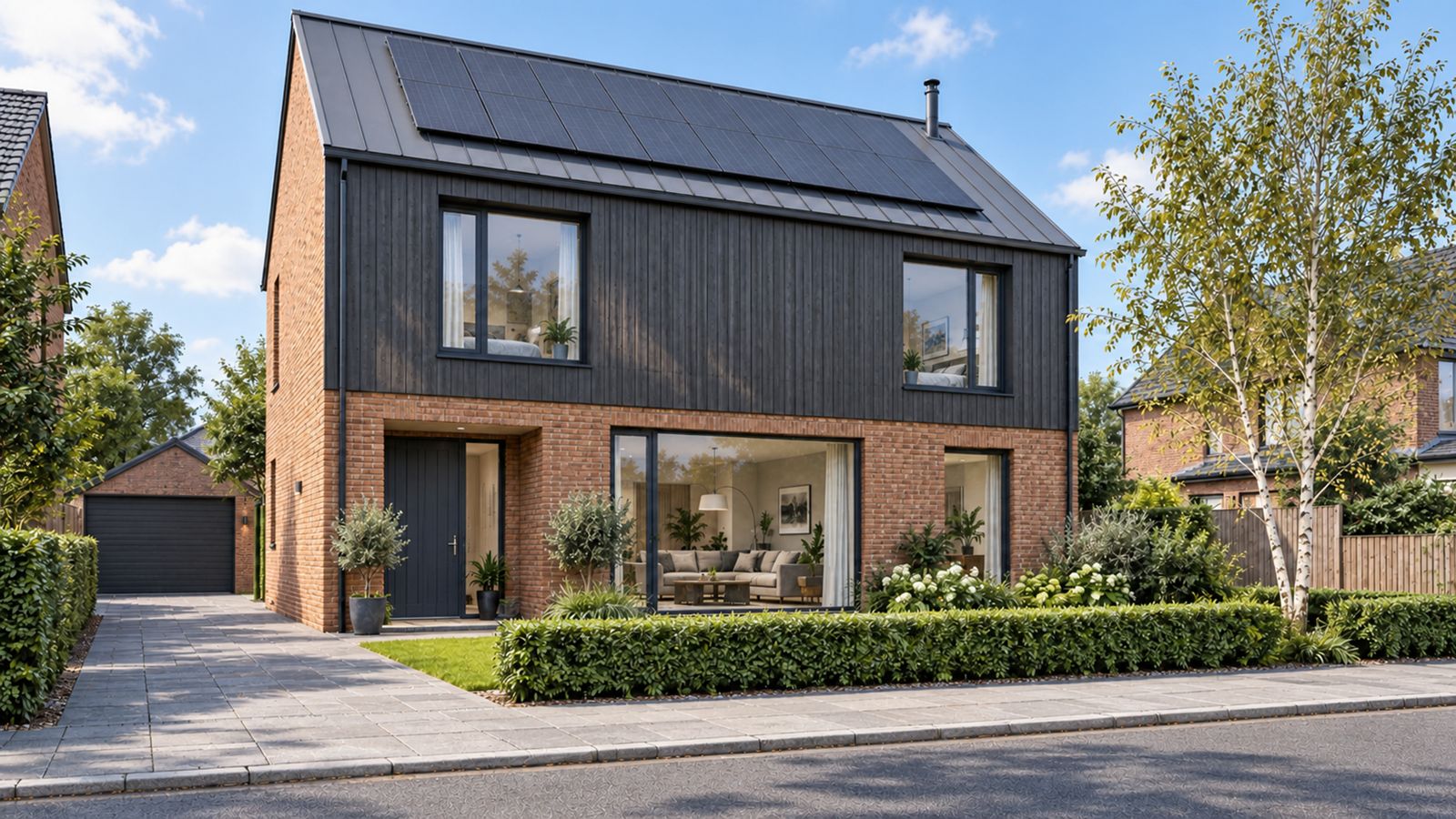
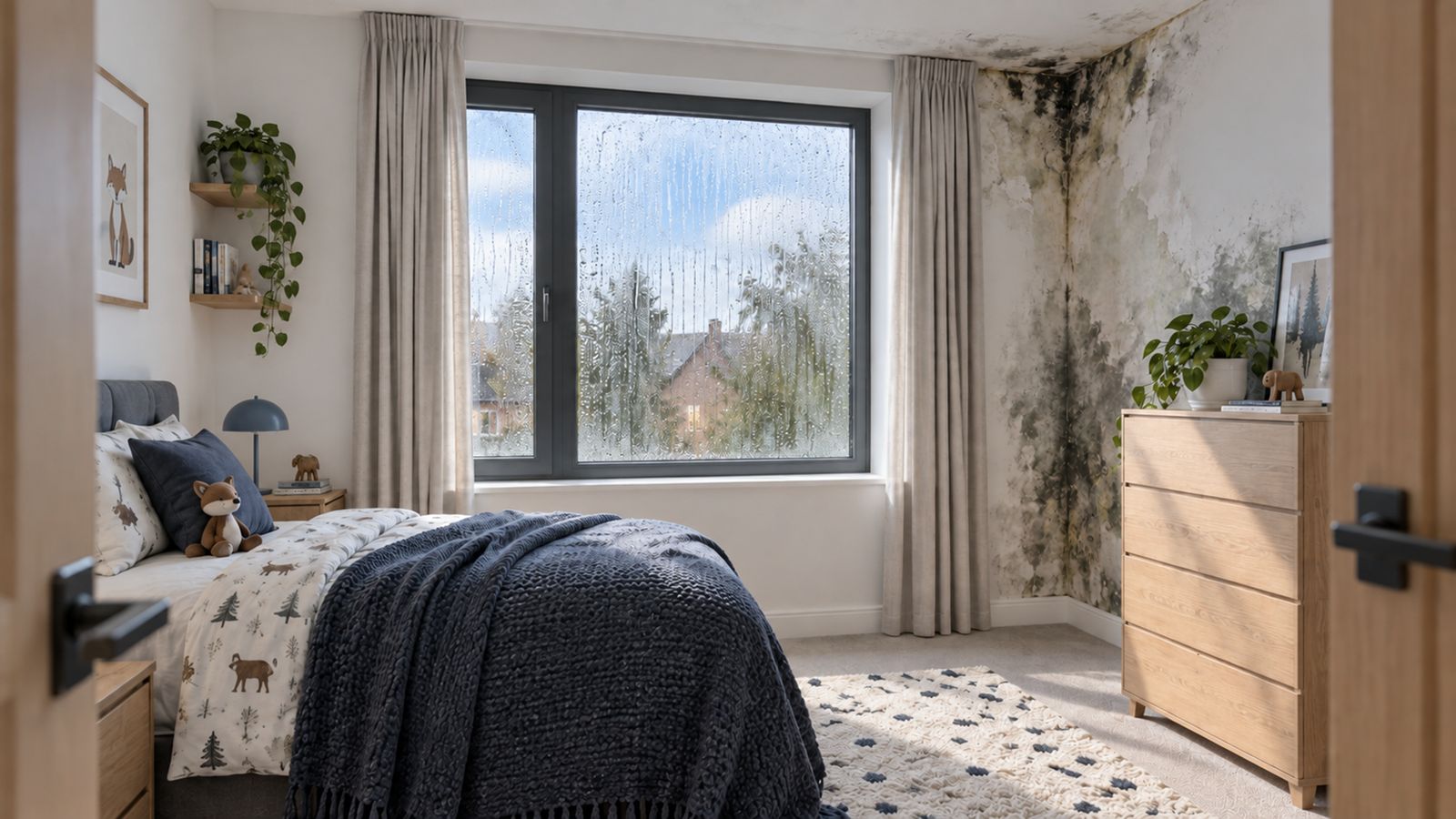
AI-integrated Digital Twins for damp and mould, personal thermal comfort and thermal resilience. Step inside the house to explore.
London South Bank University - Wates Group
Physics-informed Digital Twins for early mould prediction in social housing
Developing an AI-integrated Digital Twin for proactive mould risk management, combining IoT sensing with calibrated building simulation and physics-informed machine learning to monitor the hygrothermal conditions that drive mould growth across the building envelope.
The framework turns limited sensor data into surface-level risk intelligence, estimating conditions at both monitored and unmonitored locations and identifying localised moisture risks that room-level temperature and humidity measurements can overlook. In case-study validation, it revealed major differences in mould susceptibility across individual envelope surfaces and identified glazing interfaces and lower-resistance walls as critical hygrothermal weak points.
A physics-informed XGBoost model then forecasts mould development from 1 hour to 7 days ahead, achieving R² = 0.999 for 1-hour prediction and 0.896 at one week. At the 24-hour horizon, it reduced prediction error by 24% compared with LSTM and 53% compared with physics-based VTT forecasting.
Developed with Wates Group to support earlier intervention, targeted inspection, and preventive maintenance in UK social housing.

Physics-informed, AI-integrated digital twin framework for real-time mould growth prediction — view full size.
watch the video summary ↗
Swansea University - EPSRC SWITCH to Net Zero Buildings
AI-integrated building management system for personalised thermal comfort
Developing an AI-integrated building management framework that predicts individual occupants’ thermal comfort and translates those predictions into personalised building control recommendations for net-zero buildings across Swansea Bay and South Wales.
The research combines real-world monitoring in occupied buildings, explainable AI, and transfer learning to develop comfort models that can learn from occupant and environmental data, explain the factors driving individual comfort responses, and adapt to new buildings and populations where labelled comfort data are limited.
Working with Energy Carbon and regional partners towards more occupant-responsive building operation that balances personal comfort, energy performance, and net-zero objectives.
London South Bank University - International Collaboration
AI-driven optimisation of building envelopes for resilience during extreme heat and power outages
Developing an AI-assisted retrofit optimisation framework to determine how building envelopes can protect occupants during prolonged power outages and extreme summer heat.
Evaluated across four residential building types and 14 climate zones, optimised retrofits improved average passive survivability by 72.1%, with individual cases achieving up to a 54.7 percentage-point increase in survivability, a 25-hour delay in thermal failure, a 63% reduction in cumulative thermal stress, and an 8.3°C reduction in peak indoor temperature.
By combining BIM, EnergyPlus, XGBoost, and NSGA-II, the research identifies climate- and typology-specific retrofit strategies, showing that thermal resilience depends on balancing insulation, solar control, thermal storage, and recovery performance rather than simply maximising envelope insulation.

AI-integrated multi-objective optimisation framework for envelope retrofit strategies — view full size.